INTERNATIONAL HUMAN RESOURCE MANAGEMENT: The context of Globalization

 The organizations are working hard to take part in the world market - and the only way out is globalization or internationalization. The organizations are developing their capacities and working hard on the resources to give a better competition. They utilizes a variety of resources or capital to make their business run. The organizations involve their workers' skills and abilities to generate revenue.

Human Resource Management has been defined as the process of employing people, training them, compensating them, developing policies relating to them and developing strategies to retain them.

The concept of IHRM is much more complex and broader than HRM. The process of IHRM involves Human Resource planning, the analysis of the job position, recruitment and selection, training and career management, performance appraisal and remuneration.

The International Management also involves international firms' performance appraisal system, training for international HR departments and lastly the design of a globally appropriate remuneration strategy.

PEST Analysis:

While going global the organizations go for the PEST analysis. The factors influencing the organization and its Human Resource System are -

i) Political characteristics of the country which includes the laws, property rights, taxes, business policy, regulations, elections and patents.

ii) Economic scenario of the country which shows the nature of the same-growing, stagnate or declining.

iii) The sociocultural characteristics which inculcates the demography, health care, education, social mobility and other social factors of the country.

iv) Technological factors available in the country and how will they affect the country.

The PEST analysis will help the organization in determining about the opportunities and threats. What is happening at the global level, settle down on the risk management policies and to find out new and different markets.


IHRM and Global Strategies:

Globalization is the process of economic integration at the international level. The factors like culture, language, management styles and laws have to be considered.

The ultimate goal of the organization is to find out the 'best fit' after considering the external environment and the internal strategies of the organization; HRM policies and their implementations.

The IHRM considers the Transnational scope, when they focus more on the international or global perspective rather than domestic one.

Decisions take into consideration the needs of all employees in all countries in which the company operates. The concern is the ability to establish standards that are fair for all employees regardless of which country they operate in.

A transnational representation means that the composition of the firm's managers and executives should be a multinational one. The ideas will come from a variety of perspectives and ideas from all countries in which the organization operates. Multicultural understanding is taken into consideration, which leads to a holistic approach to HRM.


ESTABLISH A RELATIONSHIP BETWEEN PERSONALITY DEVELOPMENT AND EMOTIONAL DEVELOPMENT

Sigmund Freud was the pioneer in stressing importance of early experiences in personality development of an individual, through his studies he found many of his adult patients and their unhappy childhood experiences which had a long term effect on the psycho - social - development of those individuals. Other research studies also shows the effect of early experiences and the memories of them, even though they are highly influential because they need an indelible impression on child's self concept. There are ample evidences which shows that the attitude and emotional reactions of parents, the total cultural context and environment in which child grows up and other socio-emotional factor in child's total experience are of greater importance in determining the pattern of personality.

Emotion as a determinant of Personality development:

Usually emotional experiences faced by an individual from the very beginning of his life determines the development of his personality both directly and indirectly. How the emotion effect the self concept is greatly influenced by how other individuals in environment makes judgement about oneself.

When emotions are so strong that behaviour becomes disorganized and that will adversely affect children's characteristics pattern of adjustment by doing so, they have a profound effect on their personalities by leading to unfavourable self concept - this is how emotion directly impacts personality development of an individual.

Emotional and Personality Development - Relationship:

Frequent, intense and apparently unjustified emotional outburst lead others to judge the individual as 'immature'. Suppression of emotional experiences results in moodiness, which tends to make the individual rude, uncooperative and pre-occupied with self. Heightened emotionality even if expressions are controlled, tends to make one nervous; it is often accompanied by some specific manners like - giggling, nail biting, as a result people often think them as immature.

Children with controlled emotions are often favourably judged by people. Some typical forms of emotional expressions are more socially acceptable than others. As for example, "picking on others is more acceptable than moodiness".


SOCIAL PSYCHOLOGY - IT'S SCOPE

"Social Psychology is the scientific study of how people's thoughts, feelings, beliefs, intentions and goals are constructed within a social context by the actual or imagined interactions with others". (McLeod; 2007)

"The scientific field that seeks to understand the nature and causes of individual behaviour in social situations". (Baron, Byrne and Suls; 1989)

 Social Psychology encompasses social situational influence on psychological phenomena, personal construction of those situations, and the mutual influence of the person or situation interaction. Therefore, the scope is largely defined by the limits of what is a "social situation". This situation could be considered the relative influence of real or imagined others.

Individual Perspective:

The social psychologists are also interested in the problems of learning, perception, motivation, emotions; but they are interested in these processes only in the context of social interaction. They studies the individual behaviour in the social environment in contrast to the general psychologists who studies these processes in the context of the physical environment. So, one of the scope of social psychology is to build up knowledge so that our understanding of individual behaviour in social setting can be improved.

Social Interaction:

Interdependence usually means the degree to which individuals require one another to obtain goods and services which would not be available otherwise. Other human beings, are the most significant and consequential parts of the environment. Other persons respond to us and we respond to them and so on. Such give-and-take among human individuals is the significant aspect of social interaction. Our character, our concerns and our aspirations are in some way or the other affected by interactions with others. This is why social interaction occupies a central place in social psychology. It is by understanding the processes of interaction that we can understand the broader features of social influence, including the effects of cultural, organizational and group effects upon the individual.

Social interaction refers to the reciprocal relationship between two or more individuals whose behaviour is mutually dependent. It involves the communication process that leads to influence upon the actions and outlooks of individuals.

Interactions take place in an interpersonal situation, that is, in face-to-face relationships. But the memory of another person may also influence our behaviour even when there is no face-to-face relationship.

Social Influence:

Another important scope of social psychology is with the processes of social influence. The individual is born in a group, grows up in a group and lives and works in a group. So by necessity man is oriented toward other human beings in the environment. Social influence occurs whenever one individual responds to the actual or potential presence of other human beings.

The three factors resulting into social influence are:- a) Social interaction process, which is basic to human experience right from birth. Man's personality, his beliefs, attitudes and values are all based, in way or another, on social interaction.

b) Influence of the group on individual give rises to problem of conformity, prejudice, leadership and other group phenomenon.

c) Influence of one group on another group may either lead to cooperation or conflict.

The other variables studied under social psychology are attitude, value, group cohesiveness, group norm and many more.


References:

Kuppuswamy, B. (1961). An introduction to social psychology. Asia publishing house.

Singh, A. K. (2019). Social psychology. PHI Learning Pvt. Ltd..


THE BIOPSYCHOSOCIAL INTERACTION - PERSONALITY

 Personality is often defined as a pattern of relatively permanent traits and unique characteristics that give both consistency and individuality to a person's behaviour. 

There are a number of ways in which we describe personality. And, often when we assess it for an individual, the effectiveness with which he elicit positive reactions under different circumstances are being considered. Or, the other most popular way of ascribing an individual with a personality is by observing the most outstanding or salient impression which he forms on others.

So, personality has often been defined from two separate viewpoints, one is the 'biosocial' perspective, where a close correspondence with the popular use of the term as it equates personality to the "social stimulus value" of the individual is made. Here, the reaction of other individuals is considered to determine the type of personality.

The other is the 'biophysical' perspective which generates from the characteristics or qualities of an individual. This perspective claims for an organic side of personality which is linked to the specific qualities of the individual which are susceptible to generalized description and measurement.

The construction of an individual's personality is the result of the reciprocal interaction of the three vital determinants - Biological factors, Psychological factors and Social factors.

The Biological or Physical determinants plays a vital role in the formation of personality. It has been sub-grouped into heredity and physical features. Heredity contributes towards the sex, physical structure, composition of muscles, facial features, which are reflected through our personality. And, physical features are the external appearance which also plays a key role in the formation of self-conception.

The next is the Psychological factors which involves the cognitive aspect of an individual. The behavioural patterns, thinking and problem solving skills, decision making capabilities - all contributes towards the formation of personality.

The third in the row is the Social factors. Personality and social behaviours result from a blending of heredity and social environmental influences. The Sociobiologists feel that environmental factors have the greatest influences. Heredity, birth order,parents and cultural environment are among the principal factors which influences an individual's personality and behaviour.

These three factors are in a continuous interactive relationship and influences one another from the time of an individual's pre-natal stage. The synthesis of these factors determines an individual's personality.


MEASURING ATTITUDE

Attitude has often been defined by psychologists as people's evaluation of almost any aspect of the world.

We often posses either positive or negative responses or actions towards different social stimulus, some of them are quite flexible and can be altered, while some are resistant to alternations; as we hold some attitudes with certainty, while uncertainty prevails towards other social aspects.

Social psychologists have reportedly distinguished two types of attitudes - 

1) Explicit Attitudes - They are the conscious or report able forms. The beliefs which we are aware about and can be easily measured.

2) Implicit Attitudes - These type of beliefs are less controllable and not at all conscious or easily accessible to us.

The measurement of explicit attitude are done following varied scaling techniques or tests. The belief or disbelief, favourable or unfavourable form of attitudes are measured with the help of scales, constructed by experts having short statements dealing with several social aspects like - climate change, sexual abuse, pollution, globalization and many more social constructs.

The scales or tests are constructed following a continuum, where the scale ranges from absolute unfavourable to absolute favourable acceptance of belief. Each statement will portray a specific degree of acceptance or rejection of a belief.

The 2 most popular scales for measuring attitudes are:

1) Thurstone's method of equal appearing intervals - The Thurstone's Scale is a quantitative form of measurement of people's attitude, using 'agree - disagree' format. These statements are assigned with potential numerical values, which helps the researcher to determine the strength of the belief which one holds toward  the specific social aspect.

This is mainly applied when the researcher wants to know the attitude of individuals about a specific topic and wants to compare it with others. It is also a possible technique of collecting data in a group situation.

2) Likert's method of summated ratings - This technique of measuring attitude is much simpler than that of Thurstone, yet follows a long and elaborate steps for analyzing and elemination of weak items.

The Likert scale follows a 5 - point method, having the range from: strongly agree, agree, undecided, disagree to strongly disagree. This method of scaling attitude is much objective in nature and indicates the intensity of the opinion, also in accordance with the direction.

This is also a quantitative technique of measuring attitude, where the response ranges from being agreed upon to disagreement, also having an option of having no belief at all. The responses hold their own values but the interval values are not equal, with the limitation, that individuals can give false responses due to social desirability.

Another technique for measuring attitude is Bogardus Social Distance Scale - following the degrees of social intimacy. This scale was formed keeping in mind the social forms of discrimination which regulates our relationship formation with any stranger.

This scale has been defined, which measures the degree of closeness towards people of other social, religious, ethnic or racial groups.

The characteristics of Bogardus Social Distance Scale are : it is cumulative in nature, a 7 point scale and lastly, it measures social distance. 


WORK ENGAGEMENT IN ORGANIZATIONAL PSYCHOLOGY

 Work Engagement has been defined as a positive, affective-motivational state of high energy combined with high levels of dedication and a strong focus on work. (Schaufeli and Bakker, 2010) It is one of the most essential factor in an organization to have engaged workers, as they will provide the organization with high productivity, 'out of the box' ideas, extra effort, commitment and citizenship behaviour.

A number of research studies are being conducted on work engagement to find out the characteristics of an engaged employee, what makes a worker more engaged, and what are the several outcomes of having engaged employees in the workplace. This particular aspect helps to determine an important worker, a more engaged work team, the output of the organization. These, workers due to strong and hard work is beneficial to the organization and show better job-role performance.

CHARACTERISTICS OF ENGAGED EMPLOYEES:

1) Engaged workers have a better attitude towards overall work and organization. They want to be a part of every team, participates in formal and informal events.

2) Engaged employees often show more organizational commitment.

3) Also, more citizenship behaviour are performed by them.

4) They are much higher in belongingnes. These individuals share a good interpersonal relationship with both managers and other coworkers.

5) They are much easier and simple to work with.

6) Engaged workers are better in terms of trust and responsibility.

FACTORS THAT MAKE AN EMPLOYEE MORE ENGAGED:

The organizations always try to keep their employees engaged to elevate the rate of productivity. So, what are those vital factors which keep them high in work engagement? The answer is :

1) Job Satisfaction: Employees who are satisfied with their job, their workplace, job-role, coworkers and employers are more engaged.

2) High Interest or 'of purpose': Employees who are more interested is performing their task and find it meaningful or of some purpose are usually more engaged in their job.

3) Organizational Culture: If the culture of an organization is positive, employee - friendly, recognizes its worker's efforts and encourages the employees - likely the employees will have more engagement towards their organization.

4) Leadership: A good leader can influence the whole organization. A good leader can encourage the employees and improve the climate of the workplace. A good leader can increase the productivity of the employees and keep them engaged.

5) Pay structure: If the organization pays well then they can keep the workers engaged.

6) Autonomy: If the employees receive freedom in decision making and in performing job-role, that will promote work engagement among them. 

7) Job resources: The physical, psychological and social job resources are if supplied adequately, the work engagement of the employees remains intact.

Work engagement is very much vital for the ultimate growth and development of the organizations. The current research studies are working upon to find out the factors which promotes the counting of engaged workers. 


ORGANIZATIONAL PSYCHOLOGY - AN INDIAN PERSPECTIVE

 Like the advent of mainstream Psychology in India, the Industrial or Organizational psychology also arrived late in comparison to the Western countries. The economical structure is the biggest welcome of this particular field  - where India was lacking at the post-independence era. The main aim of organizational psychology was to raise the performance level of the employees in the western world, which was copied here. The cross-cultural studies and indigenous psychology movements promoted or made it to realize that how much organizational psychology is important in the Indian settings.

The area of Organizational Psychology was mainly based on the 'right fit', turnover or absenteeism rate, job satisfaction, work culture and climate, job performance and other related facts. These are the main concerns on the basis of which, the theories, measurements and researches were constructed in the western countries. India was lacking the advancements in technology, data and organizations, so reprinting the western form of data, theory and measurement was done here. The local touch or involvement was lacking.

During the 1970s, a lot of cross-cultural research studies started in India following western prototypes. The research studies conducted in the Indian organizations followed rigorous collection of data on the managers and their behaviours. The form of relationship they use to built with their employers or 'bosses'.

The other topics of organizational behaviours which were covered in the Indian setting was the effectiveness of teams and groups. It was concluded that the effectiveness of team was depended on the job, environmental factors and the structure of the organization, while group effectiveness is the output of internal and external processes, personality of the members. Several meta-analysis were done on the concepts of individualism and collectivism.

And, several culture-specific research studies were done on the leadership approaches. The type of leadership practiced in the Indian Organizational set-up was clarified and several models were being established and compared to reach conclusions.

Indian Organizational Psychology is a field yet to prosper. Many more researches are to be done in the local set-up, on the basis of local or culture specific data collection. As, globalization has an impact on the worldwide economic integration - Indian philosophy has a lot to contribute to the field of organizational psychology.

Industrial management in India now also have some deficits which results from lack of acknowledgement towards human factors in the industrial set-up which results into a number of issues like increased turnover, absenteeism, lesser job satisfaction, less work commitment, poor working conditions and most importantly poor or low work motivation.

So now-a-days special emphasis are being given upon the development of manpower. Human Resource Management and Development are essential now and the Management and Labour policies are being formed to provide support to the employees. Human engineering is also now focused in the Indian organizational set-up. Organizational changes and developments are being done in the Indian organizations either by following the international models or by hiring professionals from different parts of the world.

The progress in this arena is slow and needs much more financial support and expertise to reach the fullest of its development.


ORGANIZATIONAL COMMITMENT

 According to Fred Luthans (1998), "Organizational Commitment is most often defined as (1) a strong desire to remain a member of a particular organization; (2) a willingness to exert high levels of effort on behalf of the organization; and (3) a definite belief in, and acceptance of, the values and goals of the organization".

It refers to the interrelation or attachment a personnel shares with their organization or employer. Organizational commitment has also been described as an individual's psychological attachment to an organization.

Meyer and Allen, (1991) has defined organizational commitment as "a psychological state that (a) characterizes the employee's relationship with the organization, and (b) has implications for the decision to continue or discontinue membership in the organization".

While studying organizational behaviour, the researches and real life experiences, several vital actions from the part of the employees have been considered as the key roles behind the rate of productivity or output an organization shows at the end of the day. And, one of the most discussed behaviour among them are organizational commitment. It is an essential determinant for explaining employee's behaviour within the organization.

Organizational commitment shares strong correlations with many other variables like - job satisfaction, turnover rate, absenteeism or loyalty towards the organization. The job characteristics, job enrichment, and the role of the leader in terms of communication, participation and task interdependence plays a vital role in the formation of the commitment towards the organization.

MODELS OF ORGANIZATIONAL COMMITMENT:

1) The Member - Based Model - This particular model suggests that the attachment or bond originates from the behaviours and personal attributes of the employees.

2) Organization - Based Model - The organization - based model puts emphasize on the role of the organization in providing the resources to its employees and in the satisfied ways of reciprocity.

3) Three - Component Model - The most popular model of organizational commitment is the three-component model suggested by Meyer and Allen. The three forms of commitment are - a) Affective commitment - This type of organizational commitment signifies the feeling or emotional aspect.

b) Continuance commitment - The summation of the feeling aspect and cognitive aspect of the employee which leads to the thought about the consequences of leaving the organization.

c) Normative commitment - It refers to the type of commitment an employee has when he feels obliged to retain in the organization.

Lastly, organizational commitment is essential for both the employees and the organization, as it provides certain positive outcomes - listing them below;

Employee productivity, Improved organizational performance, Employee advocacy, Lower absenteeism and Decreased turnover.


References:

Luthans, F., Luthans, B. C., & Luthans, K. W. (2021). Organizational Behavior: An Evidence-Based Approach Fourteenth Edition. IAP.

Meyer, J. P., & Allen, N. J. (1991). A three-component conceptualization of organizational commitment. Human resource management review1(1), 61-89.

ORGANIZATIONAL CITIZENSHIP BEHAVIOR

 The field of Organizational Behavior is evolving everyday. Researches are being conducted to explore new arenas of OB. There are already several concepts, theories and models which are been applied to study and promote human behavior in the area of Industries and Organizations.

The popular phrases "going above and beyond" or "giving their all" are almost getting zero application in the human life. We are restricting our behavior within the stipulated boundaries and scaling them with the job role which has been assigned to us by the organization.

The modern era concept of Organization Citizenship Behavior (OCB) is reaching out the field of OB quite prominently. The OCB if explained in simple languages, is the response or actions or behaviors which are not required by the personnel. They are not a job characteristics, but are beneficial to the team and works for the organization's better functioning and efficiency.

OCB has been defined as, "individual behavior that is discretionary, not directly or explicitly recognized by the formal reward system, and in the aggregate promotes the efficient functioning of the organization". (Organ, 1997)

BENEFITS OF PRACTICING OCB: 

1) Finding one's work meaningful. The workers feel more significant and their contribution to the workplace more essential and useful.

2) Organization Citizenship Behavior increase the control ability over one's own tasks. They have a greater grip on what they are performing or how they are performing.

3) This kind of behavior helps in preventing burnout. As, the personnel identifies that his/her contribution of doing something good is of some purpose, it re boosts them.

4) OCB shares a directly proportional relationship with work-performance and productivity.

5) This is a good way to set in the organization. Employees who are new to the field can learn by practicing OCB.

There are very few disadvantages of OCB. Firstly, sometimes the behavior may get unnoticed by the supervisor or the leader. And, secondly it might lead to a poor Family - Work life balance.

TYPES OF OCB:

There are several ways in which an employee can show OCB. Past research studies highlight a few ways which are more commonly portrayed in the field of Organizational behavior.

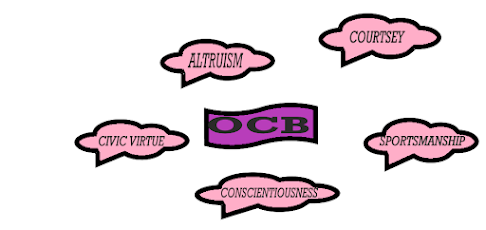
ALTRUISM: When an employee assists his/her coworkers in finishing a project, though he/she will get nothing in return. The form of OCB where an employee helps another without any expectation, is altruism in OCB.

COURTESY: Personnel when guiding the colleagues to overcome a personal life experience so that it does not effect their job performance. Courtesy is being polite or considerate towards people who work with.

SPORTSMANSHIP: Taking a rejection from the employer's part sportingly. Refraining oneself from showing frustration or hate towards the authority in time of any rejection or disagreement is sportsmanship.

CONSCIENTIOUSNESS: Attending a project work or helping in structuring a pitch which is not a part of assigned job role is showing conscientiousness. Basically putting the phrase "going above and beyond " into use.

CIVIC VIRTUE: Participating in social events organized by the company or following company's principles in personal life is affirming to the virtues of the company. When the worker represents his organization in a golden frame, his/her civic virtue is said to be high.

So, while drawing the conclusion it can be said that OCB is argued to facilitate a positive work environment, which enables organizations to attract and retain employees (Organ, 1988) and increase employee's positive beliefs toward their job and the organization.(Koopman, 2016)


REFERENCE:

Organ, D. W. (1988). Organizational citizenship behavior: The good soldier syndrome. Lexington books/DC heath and com.


Mc CLELLAND'S THREE MOTIVES

 An individual is unpredictable. Psychologists have always worked and studied the complex human behavior - the behavior which he himself often fails to explain.

In the work environment  the task assigned to a worker can be repetitive or creative. That may feel as a duty or an accomplishment. Whatever it might be, an individual acts or behaves in multivariate manner in his workplace. And his behaviors are certainly influenced by his motives, experiences, social equations and cognitive functioning.

As, the work of an Industrial Psychologist is to predict and study the employees behavior in his workplace, the cause of the same is also essential to identify.

The human behavior is at least guided by a single motive at a time. So, working upon those complex motivations are one of the important agenda.

Motivation is a complicated phenomenon. And has been described by many psychologists in various forms overtime. In the field of organizational behavior motivation and need theories have always played an essential role. The popular Need theories which we often read about are delivered by Maslow, Alderfer, Herzberg, Mc Gregor and McClelland.

McClelland in his theory of Motivation talked about three forms of motives - power, achievement and affiliation.

Need for Power (n pow): The desire to control others is the key explanation here. The urge to control and manipulate others' behavior and to achieve personalized and socialized power. An individual with high n pow will control others, work to have an impact on people around and will use other people to accomplish his motives.

Need for Achievement (n ach): The need for excellence is the priority of every individual with high n ach. The tendency is to overcome challenges and reach goals either set by others or by the individual himself. They work upon obstacles and persist on their behavior to achieve the predetermined goals.

Need for Affiliation (n aff): The desire to posses satisfying relationships is the core of need for affiliation. The characteristics of forming and continuing close relationships, getting accepted by people around and to belong to them are seen in people with high need for affiliation.


REFERENCES:

Pareek, U. N. (1988). Organizational behaviour processes. Rawat publications.


TWO FACTOR THEORY - HERZBERG

 We always do have believed that the antonym of 'SATISFACTION' is 'DISSATISFACTION', but psychologist Fredrick Herzberg introduced a different thought in his theory of Motivation. The opposite of 'Satisfaction' is 'NO SATISFACTION' and that to of 'Dissatisfaction' is 'NO DISSATISFACTION'.

The theories of Motivation of early and contemporary ones has shown more than one perspectives of interpreting the cause of an individual's motivation towards performing certain tasks. Maslow's Need Hierarchy theory has highlighted the 'Self-actualization', Alderfer's ERG theory has concentrated on the 'levels of needs', McClelland has focused on the type approach of need.

Herzberg's Two Factor Theory aimed at analyzing the contrasting view of Satisfaction and Dissatisfaction. It is a theory that bridges up intrinsic factors to job satisfaction and links extrinsic factors to job dissatisfaction. This theory is also known as - 'Motivation - Hygiene Theory'.

By following critical incident technique, Herzberg did a detailed study on the data collected from several employees. He inferred from that, the factors reportedly responsible for job satisfaction are not engaged with dissatisfaction which lead him to reach the conclusion that:

a) INTRINSIC FACTORS like advancement in job, recognition, challenges related to the job role, achievement and the work itself are responsible for an individual's ultimate motivation towards his/her job. The content factors of the job work as the 'Motivators' and leads to 'Satisfaction' - and if they are not fulfilled there is 'No Satisfaction'.

b) EXTRINSIC FACTRORS or 'Hygiene factors' as mentioned by Herzberg are those peripheral ingredients, which by themselves though are unable to bring satisfaction but can save from 'dissatisfaction'. The 'job context' factors like salary, company policy, work team, working conditions are if fulfilled properly, the employee will be 'not dissatisfied'.


REFERENCES:

Pareek, U. N. (1988). Organizational behaviour processes. Rawat publications.

Robbins, S. P. (2010). Organizational behavior. 

RANDOM SAMPLING

 The certain branch of mathematics which is concerned with the collection and interpretation of numerical data collected from the samples is called 'Statistics'.

According to Ciccarelli, "A sample is a group of subjects selected from a larger population of subjects, usually selected randomly....."

Blalock in 1960, has categorized sampling into two methods: Probability Sampling Methods and Nonprobability Sampling Methods.

Firstly, Probability Sampling Method determines the probable chance of inclusion of every unit or individual within the sample.

Secondly, Nonprobability Sampling Method is that method which is unable to provide us with knowledge of probable chance of an unit or individual's inclusion within the sample.


RANDOM SAMPLING:

The core of Behavioral Science Experimentation is 'Predict and Control'. Predicting all the factors that will act as variables and manipulating or controlling them in the hope of eliciting the perfect responses as the outcome of the experiment is the 'ideal' condition. But, this surreal situation is hard to reach, as knowing all the variables is impossible and controlling them is more inhuman.

The concept of Randomization works as a boon to this situation. When all the units or individual of a certain Universe or Population has equal and independent chance of being selected, the varied characteristics are included within the sample, which counterbalances in the long run.

So, the concept of randomness is at the center of the new era behavioral science research.

SAMPLING WITH AND WITHOUT REPLACEMENT:

Suppose we are conducting sampling with the fish bowl method. There are total 100 pieces of paper within the bowl. The chance of the 1st person to get selected is 1/100th . If we remove the piece of paper and choose the 2nd person - the chance of his selection becomes 1/99th.

a) Selection of unit or individual from the source without returning the slip is sampling without replacement.

b) Selection of unit or individual from the source returning the slips every time they were taken out, is sampling with replacement.

It can be concluded that sampling is fetching a portion of the universe or population as a representative of the same. And, Random Sampling is simply selection of this portion in such a fashion so that every individual has an equal and autonomous chance to be a part of the sample. 


REFERENCES:

Kerlinger, F. N., & Lee, H. B. (1986). Foundations of behavioral research, Fort Worth. TX: Holt, Rinehart, Winston.

Quinton, S. (2015). Saundra K. Ciccarelli and J. Noland White, Psychology (/Global Edition).

Singh, A. K. (2015). Tests, measurements and research methods in behavioural sciences. Bharati Bhawan.


ATTITUDE - BEHAVIOUR LINK

 When someone asks you "What do you feel about chocolates, the political condition of your country"? You will definitely come up with an answer as you cannot feel absolute neutral about these.

Each one of us are constantly evaluating our world around and every stimulus present around us. So, to define Attitude it can be said that - 'Attitude is the process of forming judgements about objects, ideas or people'.

"An attitude denotes an adjustment of the individual towards some selected person, a group or an institution". (Kuppuswamy)

The Attitude posses three vital components:

a) Cognitive Component: The thoughts and beliefs which are formed about any social stimulus.

b) Affective Component: The emotion or the feeling aspects attached to the social stimulus.

c) Behavioral / Conative Component: The tendency to respond or to enact in accordance with the social stimulus.

These 3 components are often put together to form the A-B-C model of Attitude.


How Attitude and Behavior is Related?

The interrelatedness between these two factors are not quite lucid. They share a complex form of linkage - which changes in respect of the stimulus, situation and other variables.

When Attitude - Behavior goes hand-in-hand?

Firstly, when we hold a strong attitude about any particular stimulus we tend to behave exactly in accordance with it.

Secondly, times when the individual is aware about his/her own set of beliefs.

Thirdly, times when there is no external or group pressure for behaving in a certain fashion.

Fourthly, he/she is not being observed by others.

Lastly, when he/she expects to have a positive consequence from that particular act.

Here, comes the concept of Predicting Spontaneous Behavior where the response of a person can be successfully predicted in a situation where he/she needs to act spontaneously. The Attitude Accessibility is the key which helps us in the guess work. The intensity of the association between an attitude object and a person's judgement of the same, when measured by the speed with which they claim how they are affected by it. This access to one's attitude or knowing the intensity of the association helps us in predicting the behavior.

The next is Predicting Deliberative Behavior, where the planned actions are guessed. The explanation behind this is easy, the thoughtful actions are often intention specific. So, if the inner thoughts or objectives of a person is known, their actions can also be predicted as well.


When Attitude - Behavior are inconsistent?

Sometimes what we say and what we do are dissimilar. For example, we may hate our Boss, say negative things about them to others; but when they are in front of us we show respect and behave cordially.

We often hold a generalized attitude about something, for example; any out-group, other religion; but does not let that reflect in our actions.

Few times our attitude and behavior are at a conflicting state. When we perceive a sense of distress or uneasiness as our thoughts and beliefs are not at par with our actions; we experience Cognitive Dissonance. 


REFERENCES:

Kuppuswamy, B. (1961). An introduction to social psychology. Asia publishing house.

Quinton, S. (2015). Saundra K. Ciccarelli and J. Noland White, Psychology (/Global Edition).


ALDERFER'S ERG THEORY

 The Need Theories of Motivation mainly focuses on the relationship between achievement and productivity. Among the most discussed need theories like Maslow's hierarchy model, McClelland's needs, Two-factor theory of Herzberg - Alderfer's ERG theory is another important one.

These early theories of employee motivation was developed during the 1950's and are still equally popular. The Content Theories focused on the determinants which motivates the personnel at work. The content theory which we will discuss now is Alderfer's ERG Theory.

Though it is said that the work of Herzberg is an extended version of this theory, but Alderfer's concept for motivation; more specifically need - is much more linear than Maslow and Herzberg. Clayton Alderfer propounded three groups of needs:

1) EXISTENCE: The need for survival or physiological well-being. The most basic to all needs.

2) RELATEDNESS: The need for having successful social or interpersonal relationships. The need to derive social recognition from people around.

3) GROWTH: The internal need of an individual for his/her own personal development. The need to express oneself in a creative manner.

He has suggested a much more of a continuous pattern of needs rather than a hierarchical model.


COMPARISON TO MASLOW'S HIERARCHY THEORY:

Starting with an example, If an individual's culture or surrounding or job environment requires him/her to give priority to interpersonal relationships, then he/she might give 'Relatedness' needs a first priority over 'Existence' needs.

So, it can be easily said that the most basic difference between these two theories is that - Maslow has focused on the Need Hierarchy levels, whereas; Alderfer had lesser limitations while generating the needs. He was much more linear and focused on an worker's immediate environmental demands.


SIMILARITIES TO MASLOW'S HIERARCHY THEORY:

The similarities are more in comparison to the dissimilarities. Maslow and Alderfer, both have promoted fulfillment of needs is the ultimate for work motivation.

The needs are being divided into several types and there are lower-order needs and higher-order needs in both the theories.

And, according to them the satisfaction of higher-order needs are more important for job satisfaction.

Lastly, more the higher-order needs are satisfied, more intense they do become.


REFERENCES:

Luthans, F. (2002). The need for and meaning of positive organizational behavior. Journal of Organizational Behavior: The International Journal of Industrial, Occupational and Organizational Psychology and Behavior23(6), 695-706.


AN INTRODUCTION TO SAMPLING

 The researches in the field of behavioral sciences are either experimental or non-experimental and aims to draw inferences about certain specific and prominent group by conducting applicable form of measurements. These 'specific' and 'prominent' groups are termed as 'POPULATION'. Therefore, a population can be defined as any distinguished and clearly defined or described group of individuals. For example; "all college students", "all parents" etc.

Population can be segregated into two types -

FINITE POPULATION: The group whose members are easily countable.

INFINITE POPULATION: The group whose size is large, so the total number of members are uncountable.

In case of performing researches, the researchers reach to the conclusions often relying on a smaller 'experience' or SAMPLE. They take a relatively small sample of the population or universe they want to draw the inference upon.

So ,"Sampling is taking any portion of a population or universe, as representative of that population or universe". (Kerlinger; 1964)

According to Kothari and Garg, "Sampling is defined as the selection of some part of an aggregate or totality on the basis of which a judgement or inference about the aggregate or totality is made".

In other words, sampling is simply gathering information about a distinguished and well-defined group by only studying a portion of it.

Thus, a sample is a representation of all characteristics of a population. The selection method of the sampling technique is called SAMPLE DESIGN.


PURPOSES OF SAMPLING: 

◘ Sampling is economical in nature, as it gives a speedy result within lesser time and involving lesser resources.

◘ In case of infinite population, sampling is inevitable.

◘ The method of sampling helps in gathering facts about the nature of the target population.

◘ Sampling designs provide accurate measurements.


TYPES OF SAMPLING: 


REFERENCES:

Kerlinger, F. N. (1966). Foundations of behavioral research. 

Kothari, C., & Garg, G. (2014). Research Methodology: Methods and Strategy. New age international.

Singh, A. K. (2015). Tests, measurements and research methods in behavioural sciences. Bharati Bhawan.


QUALITATIVE AND QUANTITATIVE RESEARCH TRADITIONS

 COMPARING QUALITATIVE & QUANTITATIVE RESEARCH TRADITIONS

'Worldview' , 'Paradigm', 'epistemologies and ontologies', or 'broadly conceived research methodologies' - are quite synonymously used in the field of research. The researcher depending on his field of study and past experiences acquired through researches choose one of the worldview or paradigms to conduct his work. The four most widely used research methodologies are - post-positivism, constructivism, transformative and pragmatism.

Logical - positivism and Phenomenological inquiry are the two prominent research methodologies or paradigms. The former one is the scientific one, most used as it includes statistical analysis and scientific assessment, referred to as Quantitative research method. The other one is more focused on detailed interpretation of phenomena, or qualitative analysis.

The Post-positivism or the so called 'scientific method' uses the technique experimentation to test the hypotheses and involves elementary manipulation, controlling of variables and statistical analysis to claim the knowledge while studying living organism's behavior. This research method is widely summoned as 'Quantitative method'. The Quantitative method is more based on a universal cause-effect relation which makes it more goal oriented, conceptual and includes proper design. This research paradigm involves prediction, hypotheses testing, statistical analysis and involves standardized tests.

The 'Social Construction of Reality' (Berger and Luckmann; 1967) and Guba's (1985) 'Naturalistic Inquiry' are ideas behind the next paradigm. Social-constructivism or Phenomenological inquiry approaches towards Qualitative research method. The main emphasis here, is to gain 'as much as' knowledge about the participant's view-point of the situation. Whereas, in Qualitative research approach there is null knowledge about things-in-themselves. It encompasses grounded theory, understanding natural behavior and observation of the target population in real life settings. This paradigm is flexible and can be altered or modified at any point of the study. Also, unstructured in nature. The open-ended questions must be framed in a way, so as to gather a clear view about the lifestyle and a broader or generalized fact.

In case of Quantitative research, the data is collected usually in laboratory setting. Whereas, in case of Qualitative research study the data is collected in natural setting, where the phenomenon has taken place and the researcher is present during data collection ensuring a good relationship with the subjects.

In Quantitative approach, the Independent variable is manipulated by the experimenter. For Qualitative approach, the Independent variable is already exposed to the subjects.

Quantitative research is done following random sampling , in case of Qualitative research it is not possible to assign samples following random sampling methods. 


To sum up all the points:


References:

Best, J. W., & Kahn, J. V. (2016). Research in education. Pearson Education India.

Creswell, J. W. (1999). Mixed-method research: Introduction and application. In Handbook of educational policy (pp. 455-472). Academic Press.


MASLOW'S NEED HIERARCHY THEORY


The term 'Motivation' has been defined by many psychologists throughout the timeline. It can be considered as something which forces or drives, elicits and zests an individual to enact or response in a certain way at a definite time for reaching a determined goal or motive.
According to Ciccarelli and White motivation is "the process by which activities are started, directed and continued so that physical or psychological needs or wants are met".

To lucidly understand the concept of motivation one must go through different theories concerning the urges, necessities, inclinations and aspirations of beings.

Abraham Maslow originated the first humanistic theory based on the hierarchy of needs (1943, 1987). The other names for the theory are Humanistic theory, Transpersonal theory, Holistic-dynamic theory, The 3rd force in Psychology, the 4th force in Personality, Need theory and Self-actualization theory.
This particular theory on the zone of motivation is based on the ladder of needs including both the fundamental needs or needs for survival, as well as, the growth needs. The stages of need hierarchy theory are as follows:

a) PHYSIOLOGICAL NEEDS: The very crude for human survival, physiological need includes the basics like hunger, thirst, sex, fatigue etc. These are the sole needs which can be completely satisfied or overly satisfied and they are recurring in nature.
b) SAFETY NEEDS: This is to feel safe and secure both in terms of physical and psychological factors. The requirement for shelter to protect oneself from any environmental threats or having a financial security - both gives the sense of being safe.
c) BELONGINGNESS AND LOVE NEEDS: We all know that human beings are social animals, we cannot live alone. This particular need concentrates on the giving and receiving of love. To be accepted by the people present in the surrounding, to be loved and to be a part of the social groups or to belong is the next on the ladder after one satisfies safety needs.
d) ESTEEM NEEDS: Self-esteem is an individual's own feeling of worth and confidence. More or less every person wants to achieve, gain approval and recognition, which fulfills their need for esteem. It is mainly based on true competence and not on others' opinions.
e) SELF-ACTUALIZATION: According to Maslow, "the point that is seldom reached at which people have sufficiently satisfied the lower needs and achieved their full human potential". Individuals who respect and survives on depending upon the B-values like truth, beauty, justice and other such factors, shows the trait of self-actualization. This is the need to discover self-fulfillment and to reach one's fullest potential.


The other needs which were later added to this theory were - Cognitive needs, Aesthetic needs and Transcendence needs.


References:

Quinton, S. (2015). Saundra K. Ciccarelli and J. Noland White, Psychology (/Global Edition).


INTERNATIONAL HUMAN RESOURCE MANAGEMENT: The context of Globalization

 T he organizations are working hard to take part in the world market - and the only way out is globalization or internationalization. The o...